
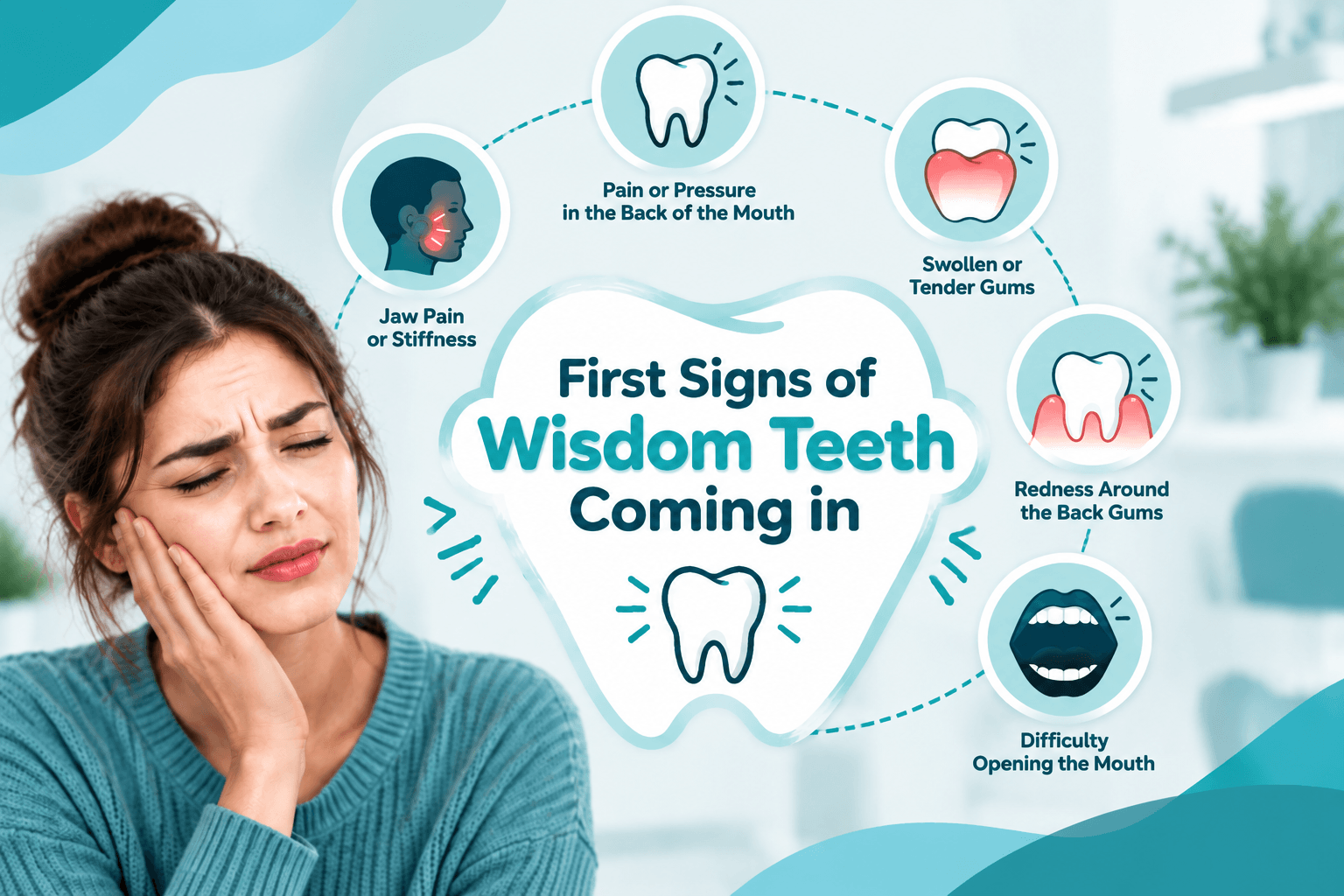
A new ache at the very back of your teen or young adult’s mouth can be easy to dismiss at first. But when the gums become sore, the jaw feels tender, or chewing suddenly becomes uncomfortable, many parents start to wonder whether wisdom teeth are beginning to come in.
Knowing the first signs of wisdom teeth coming in can help families understand what may be happening and when symptoms need closer attention.
Wisdom teeth may come in as usual, or they can become trapped, partially erupt, or present issues with the gums and surrounding teeth.
When Do Wisdom Teeth Start to Come In?
Wisdom teeth, or third molars, are the last set of permanent teeth to erupt, usually appearing between the ages of 17 and 25. The large teeth force their way through the dense jawbone and thick gums, causing changes at the back of the mouth. Recognizing early warning signs lets you handle discomfort proactively rather than reacting to sudden severe tooth pain.
Pain or Pressure in the Back of the Mouth
A steady, dull ache located directly behind your second molars is one of the most common signs of emerging wisdom teeth. This sensation occurs because the new molar is actively forcing its way through the bone and gum tissue. You may notice your teen complaining that the pain flares up for a few days and then completely disappears.
This is a regular event, and it is merely growth in micro-bursts, increasing pressure on the other structures while it grows and relieving pressure on them when it pauses growth for some time.
Swollen or Tender Gums
The gum tissue around the wisdom tooth is under significant stress as the tooth emerges. This triggers localized inflammation, which can make gums tender to the touch, sensitive while eating, or visibly swollen.
In many instances, a small flap of tissue, known as an operculum, remains over a partially erupted tooth, trapping food particles and bacteria beneath it. This localized tissue infection is medically known as pericoronitis.
Jaw Pain or Stiffness
The mechanical force of a third molar pushing against the back of the jawbone is not confined to the gumline. The surrounding jaw muscles can contract defensively in response to inflammation, causing a feeling of tightness or deep-seated soreness along the jawline. This discomfort often becomes more noticeable when biting down on firm foods or after prolonged talking.
Redness Around the Back Gums
Healthy gum tissue appears pink and firm, but the mechanical stress of tooth emergence causes hyperemia in the local blood vessels. You may visually spot deep red, inflamed patches in the very back corners of your child’s mouth.
This localized redness indicates that the body’s immune system is responding to tissue pressure and bacterial accumulation around the new crown.
Difficulty Opening the Mouth
If inflammation of a wisdom tooth spreads to an adjacent chewing muscle, such as the masseter, it may make it harder to move the jaw. This is clinically called trismus and makes it uncomfortable to open the mouth wide for eating, yawning, or brushing.
If your child complains that their jaw feels “stuck” or hurts when opening their mouth wide, there is likely significant soft-tissue inflammation.
Can Wisdom Teeth Cause Headaches or Ear Pain?
Yes, general facial pain, headaches, and earaches can be caused by wisdom teeth. The nerves in the back of the jaw are densely packed and intricate, so irritation from a third molar is unlikely to remain localized.
Knowledge of ‘referred pain’ can help explain why a toothache might cause an earache or a tension headache. The trigeminal nerve provides sensation to the upper and lower jaws, teeth, sinuses, and temples.
If the wisdom tooth presses on adjacent nerve branches, the pain signal is transmitted along the trigeminal pathway. These signals get misinterpreted, and your brain thinks they are coming from your ear, temple, or neck instead of the back molar.
Although wisdom teeth are a major contributor to these symptoms in older teens, headaches and ear pain can be caused by TMJ strain, sinus pressure, or typical tooth decay. A detailed, comprehensive dental examination of the teeth is required to determine the real cause.
Signs That a Wisdom Tooth May Be Impacted
An impacted wisdom tooth is a tooth that doesn’t grow through normally in the mouth. This is usually because human jaws are not large enough to accommodate four extra-large molars.
Some common symptoms of impacted wisdom teeth are:
- Tooth Growing at an Angle: The tooth is inclined to grow towards the neighboring molars (mesial) or towards the back of the jaw (distal).
- Not Enough Room in the Jaw: The jaw arch is too narrow, and the tooth does not come through straight.
- Trapped under the gums: soft-tissue vs. hard-tissue impaction, in which one or more molars are partially or fully hidden under the gums.
- Persistent Pain & Infection: Throbbing, swelling, bad breath, or a foul taste in the mouth that persists for a long time due to debris trapped under the gum flap.
What Can You Do for Wisdom Tooth Discomfort?
You can take a few safe home measures to relieve some of the mild tenderness and to keep the area clean while waiting for your dental appointment:
- Keep Your Mouth Clean: Maintain good oral hygiene. Gently brush the area using a soft-bristled toothbrush to remove food particles. Discover how proper habits like flossing can protect neighboring molars from decay during tooth eruption.
- Gently Brush Back Teeth: Gently clean around the back teeth 3 to 4 times a day with a warm salt-water rinse (1/2 teaspoon of salt in 8 ounces of warm water) to relieve irritated tissues and reduce bacterial buildup.
- Take Soft Foods: During a flare-up, try switching to soft, nutrient-dense foods like scrambled eggs, yogurt, soups, and smoothies to minimize pressure on tender back gums.
- Over-the-Counter Pain Relief: When taking over-the-counter anti-inflammatory medication to help relieve pain, be sure to read and follow all package directions closely.
- Understand when to seek help: Home remedies provide temporary relief, not a cure. If your child has severe swelling, fever, trouble swallowing, or pain lasting more than 2 days, please get him/her to see a professional immediately.
How Long Does Wisdom Tooth Pain Last?
Wisdom tooth pain is never constant; it comes in bursts. Symptoms are acute for 3 to 7 days when the tooth is moving, then they go away for weeks or months before the next growth spurt.
Since each individual’s jaw size, root structure, and tooth placement differ, professional Shelby Township dentists tend not to provide a strict timeline. For some, teeth erupt smoothly over several months with minimal discomfort; for others, impacted teeth cause recurrent pain over several years.
Persistent or worsening pain should never be ignored. Chronic aching usually means the tooth is trapped, causing damage to adjacent second molars or triggering localized infections that require prompt intervention.
How Are Wisdom Teeth Checked?
The evaluation of third molars is a planned inspection process to check for visible and/or hidden bone changes:
Visual Examination & Physical Exam: Dentist checks the soft tissues behind the second molars for gum inflammation, assesses whether there is sufficient space for the tooth, and evaluates overall bite alignment.
Diagnostic Dental X-Rays: Panoramic X-rays are necessary because they show the entire maxilla (upper jawbone) and the mandible (lower jawbone). They show hidden root shapes and angles, as well as close relationships between the roots and sensitive facial nerves or sinus cavities.
Next Steps: Your dentist will consider visual evidence and digital imaging to determine whether the tooth will erupt without issues or if you need to take proactive steps to prevent damage.
Schedule a routine checkup through our comprehensive general dentistry services to monitor your family’s oral development.
Conclusion
Wisdom teeth coming in usually start with a dull ache, swollen gums, or jaw stiffness at the back of the mouth. Because everyone’s mouth is different, these symptoms can range from mild pressure to sharp pain if a tooth gets trapped.
If you or your teen are experiencing discomfort, don’t wait for it to become a bigger issue. Call Pearly Smile Dental Studio today or book an appointment online to get a quick, easy checkup!


